
Gade is receiving renewed attention from orchestras and music scholars as concert programmers revisit the neglected corners of 19th-century European Romanticism. Born in Copenhagen in 1817, Niels W. Gade built a career that linked Danish musical culture with the influential Leipzig scene, yet his name has remained far less familiar to audiences than those of Mendelssohn, Schumann or Brahms. That gap is beginning to narrow. Recordings, anniversary programs and performances by Scandinavian ensembles have placed Gade’s symphonies and orchestral works back into circulation. The appeal is easy to understand once the music is heard live: Gade writes with a firm command of structure, but his scores also carry a distinctly northern atmosphere, filled with broad melodies, dark woodwind colors and sudden flashes of folk-inspired energy. For listeners used to the standard Romantic canon。Gade offers recognition without repetition.
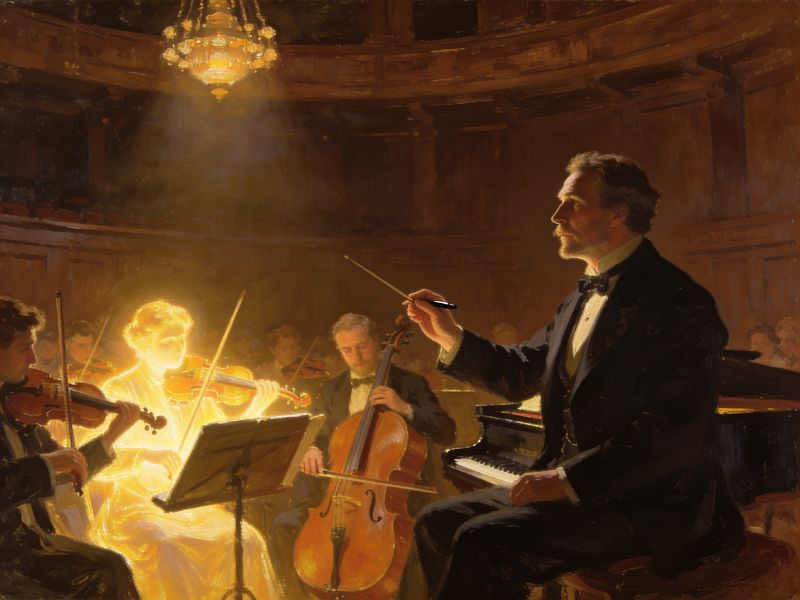
Gade’s rise began with a work that announced both his ambition and his sense of place. His overture Echoes of Ossian, premiered in 1841, drew attention for its dramatic atmosphere and national character. The success earned him a travel grant, sending Gade to Leipzig, where he encountered Mendelssohn and became part of the city’s highly competitive musical life. Gade later served as assistant conductor of the Gewandhaus Orchestra and took over several conducting duties after Mendelssohn’s death. Those years shaped Gade’s balance between lyrical invention and disciplined orchestral writing. He did not simply imitate German Romanticism. Instead, Gade absorbed its methods and redirected them toward Danish subjects。Nordic landscapes and a musical language that often feels spacious rather than theatrical. His First Symphony, written during this period, made the point clearly: the work speaks in the international vocabulary of the era, but its emotional landscape remains unmistakably Scandinavian.The recovery of Gade’s reputation has also exposed how uneven the classical canon can be. A composer’s disappearance is not always a judgment on quality;it may reflect changing tastes, publishing decisions, national politics or the practical difficulty of keeping large orchestral works in rotation. Gade’s music suffered from several of those pressures. His symphonies require serious rehearsal time, while famous alternatives arrive with built-in audience recognition and decades of critical commentary. A conductor choosing Gade must make a case before the first downbeat. In recent performances。that case has often rested on contrast. A familiar Beethoven symphony may be paired with Gade to show how differently two composers handle tension, or a Danish choral work may be used to reveal the cultural world behind the orchestral scores. Such programming turns Gade from a historical footnote into a living musical question: what else has disappeared simply because concert habits became too narrow?Listeners who encounter Gade through his chamber music may find an even more personal voice. His violin sonatas and piano works contain fewer grand gestures than the symphonies, but they show an ear for conversational detail. Phrases pass between instruments naturally。
and the writing often leaves room for performers to shape the music rather than merely execute it. That quality has made Gade attractive to smaller ensembles searching for repertoire beyond the familiar Beethoven and Brahms selections. Musicians also point to the emotional restraint in Gade’s work. He rarely pushes a climax past its natural limit, and the result can feel less like a public declaration than a memory gradually coming into focus. In a crowded cultural market, that quietness may be an advantage. Gade does not demand instant admiration;he rewards sustained attention.The current interest in Gade is unlikely to turn him into a household name overnight, nor should it. Musical rediscovery works better when it grows through repeated encounters rather than publicity campaigns. A well-recorded symphony, a persuasive program note and a conductor willing to give the score space can do more than a grand revival slogan. Gade’s importance lies partly in the bridge he represents: between Copenhagen and Leipzig, national identity and international style。public ceremony and private expression. His music also challenges the assumption that the Romantic era has already been fully mapped. Each new performance adds another detail to that picture. For audiences, the reward is practical as well as historical. Gade offers orchestral music with sweep, craft and a strong sense of place—and, after years at the edge of the repertoire, he is finally being heard on his own terms.